Sprungmenü:

Main information:
Würzburg Residence
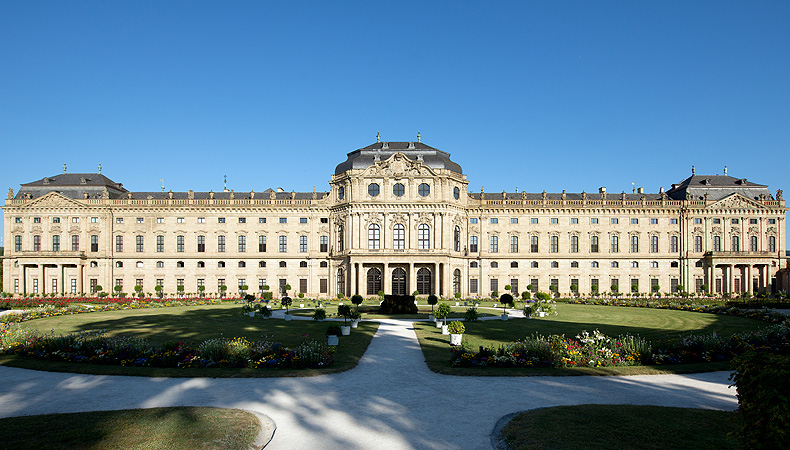
Building phases – chronological table
Prince-Bishop Johann Philipp Franz von Schönborn (reigned 1719-1724)
Court architect: Balthasar Neumann
-
Foundation stone laid on 22 May 1720
-
Construction of the north block started
Prince-Bishop Christoph Franz von Hutten (reigned 1724-1729)
Court architect: Balthasar Neumann
-
Completion of the north block 1729
-
All other building work is stopped
Prince-Bishop Friedrich Carl von Schönborn (reigned 1729-1746)
Court architect: Balthasar Neumann
-
Building of the south block from 1730
-
Cour d'honneur front completed 1732/33
-
Work on the central building and decoration of the court church with the participation of Lucas von Hildebrandt from 1735 on; consecration of the court church 1743
-
Construction of the main staircase 1737
-
Completion of the garden front 1740
-
Decoration of the Southern Imperial Apartments and the Mirror Cabinet 1740-1745
-
Completion of the vaulted ceilings over the Imperial Hall and the White Hall 1742
-
Completion of the vault over the staircase 1743
-
Stucco-work in the White Hall created by Antonio Bossi 1744/45
-
Completion of the shell in December 1744
Prince-Bishop Anselm Franz von Ingelheim (reigned 1746-1749)
-
Balthasar Neumann falls out of favour.
-
Building work on the Residence ceases until the death of Anselm Franz von Ingelheim in 1749.
Prince-Bishop Carl Philipp von Greiffenclau (reigned 1749-1754)
Court architect: Balthasar Neumann
-
Completion of the stucco-work by Antonio Bossi in the Garden Hall 1749
-
Completion of the ceiling painting in the Garden Hall by Johann Zick 1750
-
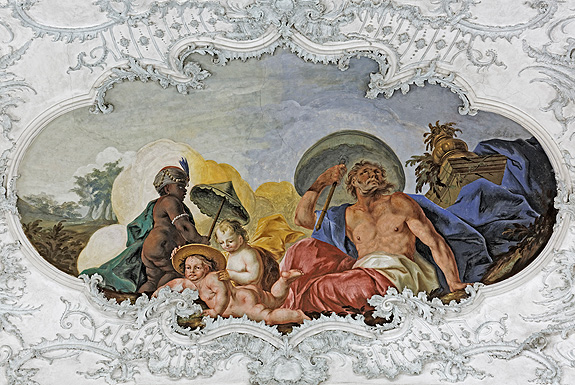
Imperial Hall decorated with frescos by Giovanni Battista Tiepolo 1751/52
-
Creation of the ceiling fresco above the staircase by Giovanni Battista Tiepolo 1752/53
-
Death of Balthasar Neumann 1753
Prince-Bishop Adam Friedrich von Seinsheim (reigned 1755-1779)
-
Stucco-work decoration over the staircase and in the First and Second Guest Rooms of the Northern Imperial Apartments by Materno and Ludovico Bossi 1765-1767
-
Decoration of the Green Lacquered Room 1769-1772
-
Completion of the Princes' Hall 1772
-
Decoration of the Ingelheim Rooms, including stucco-work by Materno Bossi 1776-1781
Prince-Bishop Franz Ludwig von Erthal (reigned 1779-1795)
Interior of the Ingelheim Rooms completed 1781
Fürstbischof Georg Carl von Fechenbach (reigned 1795-1802, then bishop until 1808)
The episcopal principality of Würzburg was abolished with secularization. After an eight-year interregnum by Grand Duke Ferdinand of Tuscany (reigned 1806-1814) in 1814 Würzburg became part of the kingdom of Bavaria.
The wrought-iron gates across the cour d'honneur, which had effectively separated this inner area from the large Residence Square, were demolished in 1821. In their place today is the Franconia Fountain created by Ferdinand von Miller the Younger. This was unveiled in 1894 as a tribute by the city of Würzburg and the whole of Franconia to Prince Regent Luitpold, who was born in 1821 in the Würzburg Residence.
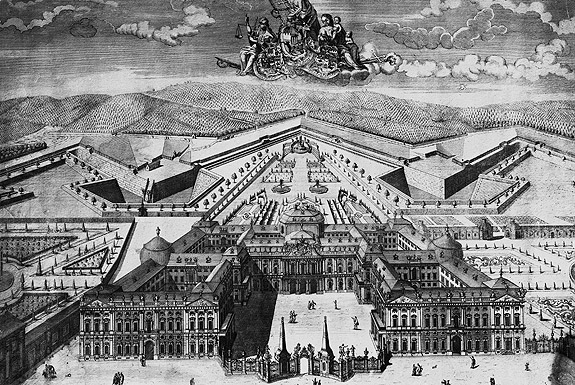
The Würzburg Residence with cour d'honneur gates
(engraving, 1757)
Photo: Bayerische Schlösserverwaltung
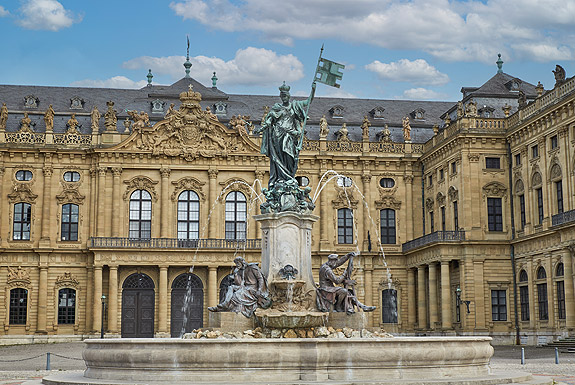
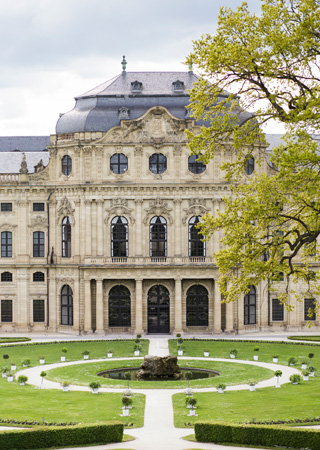
Façade of the Residence with Franconia Fountain
Photo: Bayerische Schlösserverwaltung, Andrea Gruber
The Würzburg Residence as a museum
1921: Opening of the Residence to the public
War damage and reconstruction
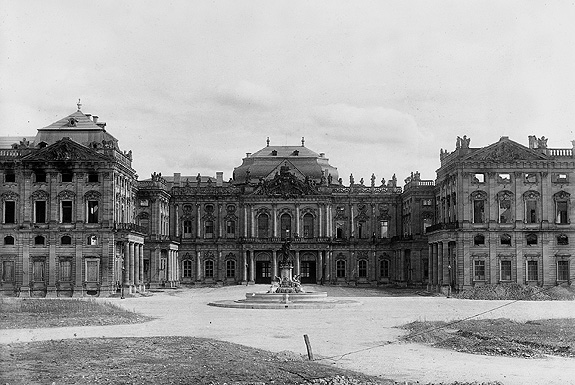
The war-damaged Würzburg Residence with the first new roofs in 1947
Photo: Bayerische Schlösserverwaltung
-
16 March 1945: As a result of a devastating air raid, the Residence burnt out almost completely and only the central building with the vestibule, Garden Hall, staircase, White Hall and Imperial Hall survived the inferno, apart from the roofs. Much of the furnishing and large sections of the wall panelling of the period rooms had been removed in time and thus escaped destruction.
-
1945: Commencement of reconstruction
-
1950: Most of the roofs on the central building have been rebuilt.
-
1963: The restored court church is reopened to the public.
-
1970: Completion of the Southern Imperial Rooms
-
1974: Completion of the Northern Imperial Rooms
-
1978: Reopening of the Ingelheim Rooms and the Princes' Hall
-
1981: The Würzburg Residence, together with the Residence Square and Court Garden, is included on the UNESCO's World Cultural Heritage List and thus placed under special protection.
-
1987: The rebuilding process concludes with the reopening of the Mirror Cabinet in the Southern Imperial Apartments, reconstructed in all its detail.


Facebook Instagram YouTube